A publication
of The Fiber Optic Association Inc. (FOA), the international non-profit
professional association of fiber optics and certifying body for fiber optics.
Updates At FOA
Fiber U
Fiber U Splicing Course
Educational Programs
Textbooks
FOA Textbook On Premises Cabling
GPON Troubleshooting Manual
Wireline- A Word To Forget
Seen On The Street
New Edition Of FOA Book On Testing
FOA Broadband References Updated
Kenya Lulu Network - With Redundancy
Are We Ready For 6G?
Locating Crisis - Keeping Up With Fiber Boom
Thailand-Myanmar Rogue Cable
Underground Dig-Up Incidents Rose in 2025
Just How Useful Is IEC 61300-3-35?
Advanced GPON Fault-Finding Manual
More Information on MCF
FOA Installation Standard Worth
ReadingInteresting
articles to read, watch or listen to. Q&A Interesting questions from our readers. This month features OTDR Testing
Workforce Training/FiberU Types Of Work Done By Fiber Techs
FOA-Approved School News
Fiber U Courses Resources New FOA Technical Resources
Trademarks:
The FOA logo and name, CFOT® (Certified Fiber Optic Technician) and
Fiber U® (the FOA online learning site) are
registered trademarks of the FOA.
To
keep your FOA certifications active, you need to
renew them when they expire every 3 years. You can use your credit card or
PayPal account or your credit card to renew your
certifications.
FOA
has 3 LinkedIn Groups FOA
- official page on LinkedIn - covers FOA, technology and jobs in the fiber optic
marketplace FOA
Fiber Optic Training - open to all, covers
fiber optic technology and training topics Grupo
de La Asociación de Fibra Óptica FOA (Español)
When founded in 1995 to help train and certify a
workforce to build the fiber optic networks needed for the Internet and
new generations of communications, FOA stated as its charter "to promote
professionalism in fiber optics through education, certification and
standards." FOA worked very hard to keep our materials up-to-date to ensure it represented the latest
technology while retaining the history that shows how fiber optics got
to be what it is today. Furthermore, while many of the founders
were from companies, we promised the FOA technical reference materials
and training would be non-commercial and free.
FOA is continually updating our technical
reference materials to keep up with the latest in technology and
applications. We've been particularly busy recently as readers of this
Newsletter have noticed. This month we summarize these recent
accomplishments, noting another textbook update (Premises Cabling) and
some major upgrades at our site for free online learning, Fiber U.
FOA made some major updates to Fiber U. but what
will be most obvious will be the new user interface for the Fiber U
Certificates of Completion and certificate management system. FOA
created our own test system that offers free Fiber U Certificates of
Completion for all online self study courses and keeps records all your
competed Certificates so you can access them online at any time.
The new page at Fiber U that links you to all the tests
now includes directions, a sorting button for test names to help find
the test you want, and in the upper right-hand corner a link to find all
your Certificates.
Here's what a Fiber U Certificate of Completion now looks like:
A new feature allows you to access your portfolio of Fiber U
Certificates of Completion using your email address. You get a list of
all your certificates.
Fiber U continues offering the same courses, all based on the material in the FOA Online Guide
and textbooks. These courses are aimed at adults, not kids, and expect a
10th grade student level of understanding of language, math and
science. Several of the courses are available in multiple languages.
Some courses are aligned to FOA certifications which makes them
excellent study guides and the Certificate of Completion tests are
excellent practice tests for those preparing for the FOA certification
exams. There are also courses aligned with the FOA badges
(microcredentials) which are excellent preparation also.
New Fiber U Course - Splicing
Here
at FOA, we were even surprised that we never created a course just for
splicing. When asked how to prepare for the CFOS/S certification, we
sent people to the lessons in Basic Fiber Optics and the Basics Skills
Lab on splicing and termination. But now Splicing
has its own Fiber U self study course. The course also includes some
new material from the FOA Online Guide on splicing and SOCs. Now Fiber U
seems more complete.
New Academic Programs In Broadband and Fiber Optics FOA has a giant worldwide network of FOA Approved Schools that
train technicians for FOA Certification. FOA also receives many
inquiries from colleges and high schools that wish to include Fiber
Optics or Broadband in their school courses for science, engineering or
even business.
For those schools, FOA has created two new programs aligned to the FOA
microcredentials (Badges) in Fiber Optics and Broadband. These courses
do not include the extensive hands-on labs for FOA certification courses
which reduces the investment and instructor training requirements. They
have complete curriculum to accompany the textbooks with Instructor
Guides, slide presentations and textbook guides. Schools are not
required to complete the comprehensive accreditation process required to
become a FOA Approved School; they just need to register with FOA to
license the curriculum.
Of course, these same courses are available for current FOA Approved
Schools also, if their school has academic programs beyond technician
training for workforce development.
More Information on the FOA Microcredential (Badge) Programs in Fiber Optics and Broadband.
Fiber U Textbooks
FOA has been on a program to update all our educational programs,
starting with our textbooks. Recent updates include the basic fiber
book, broadband, design and project management, testing and, this month,
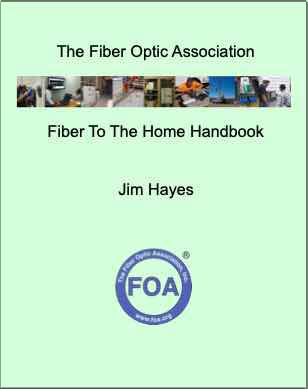
premises cabling book. Next will be the FTTH handbook and outside plant
textbooks, planned for 2027. That will complete a cycle of updating all
out textbooks to ensure they contain the latest information.
The FOA Online Guide
is updated continuously. With almost 1,000 pages of technical material,
we're always updating individual pages and adding technical articles
(like the GPON Troubleshooting Guide below) to provide the latest
information. The FOA Guide is the basis of all the Fiber U self-study
programs, so they are also kept up to date.
FOA School Program curriculum is updated
after we update the textbook and FOA Guide to incorporate the latest
technology and applications information into the training programs
offered by FOA schools to ensure they are providing the latest
information to their students. Certification exams are the final update,
but not until we ensure the training programs have incorporated
the updated materials.
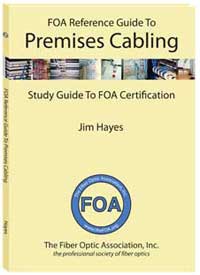
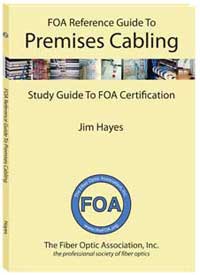
FOA Reference Guide To Premises Cabling Updated
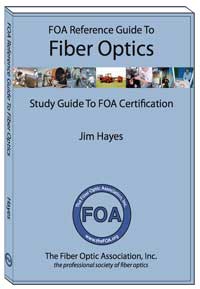
FOA is continuing updating all the textbooks in our series and the FOA Reference Guide To Premises Cabling
is the latest one completed. This book was introduced as a complete
book for premises cabling, not limited to copper cabling but adding
fiber optics and wiring, essentials in any premises cabling project.In
various updates over the years, we've added data centers and optical
LANs along with new tech in components in and applications.
In this edition we update the technology covered and expand on data
centers to include AI data centers ("AI factories"). We also revised to
book for easier reading and added a comprehensive index.
The book is available from Amazon as a paperback or Kindle edition.
Advanced GPON Fault-Finding Manual
FOA is always adding technical publications to our online Guide. Joe
Botha of Triple Play Fiber Optics in South Africa was asked by a
customer to create a document and training on troubleshooting GPON and
this is the manual he created. Joe is also author of the FOA book on
outside plant construction and regular contributor to our technical
knowledge base.
How difficult can it be to find a PON fault using
intelligent Optical Link Mapper (iOLM)? You press start, sit back and
whoopee, the fault is displayed. Piece of cake, right? Wrong!
Joe Botha's GPON Troubleshooting Guide provides a systematic approach to
troubleshooting on a Passive Optical Network (PON) network. The example
architecture chosen is a 1:4 Primary Splitter + Four 1:16 Secondary
Splitters and thus, a 64 Optical Network Terminal (ONT) PON. Even though
several different architectures are being deployed today, the
fault-finding methodologies outlined in this guide will invariably
remain relevant and can be applied across the board.
Another Obsolete Word To Remove From Our Vocabulary
A recent headline used a another obsolete term we need to purge from our vocabulary: "Wireline broadband providers ask the FCC for shorter permitting shot clock
" at Telecompetitor. Wireline or wire means copper, right? The article
is about the permitting issues for new networks, and it is highly
unlikely that those networks would be copper.
The term "wireless" makes sense, since radio does
normally replace copper wires. But what's a good term for fiber
networks? "Landline" is often used to contrast with wireless or
cellular links.
AT&T’s CEO John Stankey used the terms "fixed" and "fiber" when he said, “There’s a
fallacy to say there’s fixed networks and wireless networks. There are
only fiber networks with different access technologies on the end of
them."
And please, PLEASE, publishers, will you stop
illustrating articles about fiber networks with pictures of unshielded
twisted pair copper connectors (Cat 5, Cat 6A). It happened twice this
month.
Seen On The Street
A tornado in Tennessee destroyed this old copper splice closure. (Thanks to FOA instructor Mike Fong)
FOA Instructor Ian Gordon Fudge of Fiberdk
spotted this in Spain. It is a splice tray that appears to be part of a
FTTH network hanging outdoors with no splice closure to protect it.
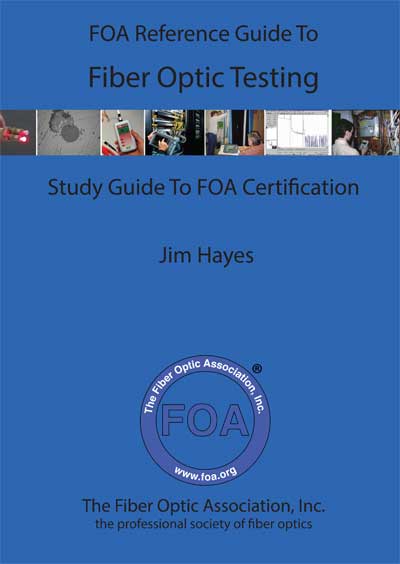
New Edition Of FOA Textbook On Fiber Optic Testing
FOA has published the Second Edition of The FOA Reference Guide To Fiber Optic Testing. The textbook has been updated to include new technology, equipment and practices plus a more comprehensive index. The FOA testing textbook is the reference for
FOA CFOS/T Specialist Certification In Fiber Optic Testing in classroom
training and online training at Fiber U.
List
Price:$35.95 paperback, $16.95 Kindle Available in paperback and Kindle
versions from Amazon.com
and other booksellers.
Broadband Updates
FOA has been updating our references and courses for Broadband.
FOA Program And Microcredential In Broadband
Now, at the request of both schools and individuals,
FOA has created a
Broadband education program. We updated the Broadband book to make
it a textbook, created a complete curriculum and instructor guide for use by schools, and created a Fiber U online course. We also created a microcredential in Broadband.
New Video Lecture - Understanding Broadband
FOA has added a new YouTube video lecture to our series on fiber optics. Lecture #74 is Understanding Broadband.
This lecture was created for the same reason that we created a textbook
on Broadband - everybody talks about it but not everybody really knows
what exactly Broadband is, how it was developed and how it is delivered
(mostly on fiber optics, of course.)
This short lecture (about 15 minutes) explains Broadband in a
non-technical way to allow not only the techs to understand it, but also
the planners, business people and the general public to understand it.
Update - 2nd Edition: The Fiber Optic Association Reference Guide To Broadband
A
new edition of the FOA broadband book is now available. It's updated
for new tech like LEO satellites and, at the request of our schools,
been expanded to include chapter questions and a comprehensive index to
facilitate using the book as a textbook for classes.
The new edition is aimed at teachers who want to include
communications technology in their classes. It is appropriate for a
module or semester course for engineering, science or even management
students. It is intended to be an introduction to
communications technology
appropriate for a communications course at almost any level (junior
high, high school or
college,) as well as for managers involved with broadband projects.
Paperback and Kindle versions available from Amazon or most booksellers.
-----------------
Fiber U Broadband Self Study Program
FOA has added a new Fiber U self-study program
on Broadband, The course includes 10 lessons that cover the full scope
of broadband technologies. Like all Fiber U courses, it's free, and after you complete the course
you can get a Certificate of Completion for a nominal cost.
The FOA website and the FOA Online Guide
include what is probably the
largest knowledge base in fiber optics. We provide links,
contents pages and a search engine, but the amount of content is
daunting. Ask Lennie is
now available to search the FOA website using AI.
Ask Lennie Lightwave is waiting to help answer your questions and find things on the FOA Website.
Classroom
Resources For STEM Teachers In K-12 And Technical Schools Here is the POF kit sent to teachers for demonstration.
Teachers in all grades can introduce their students to fiber
optic technology with some simple demonstrations. FOA has
created a page for STEM or STEAM (science, technology,
engineering, arts
and math) teachers with materials appropriate to their
classes. Fiber
Optic Resources For STEM Teachers.
"About 20% of Americans subscribe to landline
service, while more than 90% use broadband." Scott Jordan, a professor
of computer science at the University of California, Irvine, speaking at a Benton Institute meeting.
Kenya "Lulu" Network Combines Land And Sea Routes For Reliability
The
LuLu — Kenyan Coastal Cable System is engineered to address localized
connectivity gaps along Kenya's Indian Ocean shoreline by pairing a
high-density subsea optical backbone with an integrated, parallel
terrestrial protection route. Lulu comprises of ~500 km coastal subsea
deployment along the Kenyan shoreline with 5 landing points with
redundant cables on shore for reliability.
The LuLu Cable System is spearheaded by a multi-stakeholder consortium
comprising ICT infrastructure developers, local landing parties,
industrial zone operators, regulatory advisors, and financial
institutions. It is designed for a 25-year operational life with
centralized network management. The network is planned to be ready for
service in Q2 2028.
The most consequential international conference
you’ve never heard of — the World Radiocommunication Conference 2027
(WRC-27) — is scheduled to take place next fall in Shanghai, and will
host up to 194 countries for an intense negotiation on which frequencies
to use to build the next generation of wireless networks, as covered in
a new Washington Post Intelligence report.
To those who don’t closely follow telecommunications policy, it’s worth
clarifying the stakes: The next generation of 6G networks will serve as
the underlying infrastructure for everything requiring instant
connections, from self-driving cars, autonomous factories, robots, and
the AI ecosystem of data shuttling between devices and the cloud.
International standard makers are expected to craft the first
specifications for what 6G will technically look like in early 2029,
which will in turn kick off billions of chips, software, and network
carrier investment that will be locked in for a decade or more.
But first, countries from across the world will decide how to allocate
different radio bands for 6G use — and, in particular, the 6 GHz band
that carries across sufficient distances but also can move a lot of
data. The U.S. opened the entire 6 GHz band to unlicensed use for WiFi
in 2020, but China has been building in the other direction and
dedicated the upper band to licensed mobile.
From the Washington Post Intelligence Newsletter
350-meter, 48-core cable was supplying illegal border casino and a scam center with 6TB of data per day.
Thai authorities have reportedly busted an 'audacious' criminal gang
scheme, in which hundreds of meters of fiberoptic cable were found
running across the border of Thailand into Myanmar. The cable was found
to be serving an online scam compound in the country, which included an
illegal border casino and a suspected scam center, SCMP reports.
According to the report, officers were called to homes in Nong Lu, a
village in the border province of Kanchanaburi. The province is a
gateway to Myanmar's Three Pagodas Pass, which is described as "a
notorious hub for cyber scammers." Police reportedly found "two
ramshackle village homes" using up enough daily internet bandwidth to
power an entire village. What they found at the scene of one property
was a 48-core fibre optic cable with a robust covering, strung up along
pylons and stretching 350 meters (1,100) feet across the border. The
cable was being used to siphon bandwidth out of Thailand and into
Myanmar for illicit, criminal activity.
Well, again this month, it sure seems like it!
And most of the stories seem to be either hype about how great it will
be or how great the companies developing it are or doom and gloom about
how AI is going to cause the next financial crisis or the AIpocalypse.
So no AI news this month.
From The New Book About Underground Disaster Prevention
The Locating Crisis: Can We Keep Up With the Fiber Boom?
Photo courtesy of Scott Landes
Every mile of new fiber creates two damage-prevention challenges:
First, contractors installing it must safely work
around the utilities already underground. Secondly, once installed, that
fiber becomes another facility that must be accurately located and
worked around for decades to come. That makes locating one of the most
important, and increasingly stressed, parts of our underground
infrastructure protection system.
The challenge is scale. Broadband expansion,
utility upgrades, road construction, and other infrastructure projects
are generating enormous numbers of locate requests. At the same time,
locating has become more complicated. Records can be incomplete or
inaccurate. Abandoned facilities create confusion. Multiple generations
of infrastructure occupy the same rights-of-way. Large projects can
generate extensive marking requirements. All of this against the
backdrop that currently 50 million miles of buried pipes, cables, and
wires are already in the ground.
Fiber presents its own challenges. Unlike metallic
facilities, fiber itself cannot be detected electromagnetically unless
it is armored. Locators often depend on tracer wires, conductive
components, access points, records, and other methods to determine where
a fiber route actually lies.
When locating fails, the consequences extend far
beyond the repair cost. A single damaged fiber can interrupt
communications for businesses, emergency services, hospitals, data
networks, and thousands of customers.
The fiber industry therefore has an enormous stake in strengthening the
locating system, not simply because fiber contractors need accurate
marks, but because tomorrow's locators will need to find the fiber being
installed today.
Technology will help, but technology alone isn't
the answer. Better records, training, accountability, communication, and
a stronger damage-prevention culture all matter.
The
evolution of locating and the challenges facing today's
damage-prevention system are explored in greater detail in Holding Back
Disaster: Protecting Lives and Infrastructure Through Excavation Damage
Prevention, which examines the history, challenges, technology, and
future of protecting underground facilities.
Underground Dig-Up Incidents Rose in 2025 According To DIRT Report
The Common Ground Alliance
released preliminary finding of the 2025 "DIRT" report (DIRT =
Damage Information Reporting Tool) that showed an increase in
dig-up incidents last year, with the majority of damage sustained
by telecom and CATV networks. You can read about the DIRT report in CI&M and you might enjoy reading the new book on underground disaster above.
Quote Of The Year (maybe Century!) (this is worth repeating)
Speaking at the Goldman Sachs Communacopia +
Technology Conference, AT&T’s CEO John Stankey said, “There’s a
fallacy to say there’s fixed networks and wireless networks. There are
only fiber networks with different access technologies on the end of
them. That’s where this is all going.”
Technical
Fiber optic
technology, standards, equipment, installation,
etc.
The FOA
Update Pagecovers the new technology
and applications we covered in this newsletter
recently. Now you can review all that new tech at
once.
Cross Reference To FOA Technical Reference Materials
The FOA has almost 1,000 pages of technical information on the FOA Guide,
100+ videos and two dozen online courses at Fiber U, all this can make
it difficult to find the right information.
Cross Reference To FOA Tech Materials
To help this, we have created a cross reference guide to the textbooks,
Online Guide and Fiber U courses, all the FOA technical information.
Besides the textbooks, online Guide and Fiber U, each section of the
Guide also includes links to the 100+ FOA videos available. Cross Reference Guide to Textbooks, Online Guide and Fiber U
FOA Videos
We have also rearranged the 100+ FOA videos in similar categories on the
Contents Page of the Online Guide, making the videos, especially the
lectures, much it much easier to find a video on a particular
topic. FOA Videos Guide.
Want to know more about fiber optics? Study
for FOA certifications? Free
Self-Study Programs are on Fiber
U®
Just How Useful Is IEC 61300-3-35?
Vladimir Grozdanovic
The
cleanliness of optical connectors is one of the important factors
affecting the reliability of optical networks, yet its importance is
often underestimated in practice. Connectors are often either not
cleaned at all or are cleaned improperly. Contamination can increase
insertion loss and reflectance, and it can even cause the interruption
of one or all services on a network. In addition, it can cause permanent
damage to connector end faces. And a dirty connector can contaminate or
damage clean connectors.
Connectors, as well as the contamination present on them, have a
three-dimensional structure. This is something we must always keep in
mind if we want to ensure proper cleaning and reliably clean connectors.
IEC 61300-3-35, Edition 3.0, defines visual inspection procedures and
criteria for assessing the condition of connector end faces. However,
visual assessment is limited to specific surface zones, while the
vertical dimension — that is, the height and three-dimensional structure
of contamination — is not assessed in the same way. In other words,
inspection is based primarily on a two-dimensional image of a
three-dimensional surface and its contamination.
How difficult can it be to find a PON fault using
intelligent Optical Link Mapper (iOLM)? You press start, sit back and
whoopee, the fault is displayed. Piece of cake, right? Wrong!
Joe Botha of Triple Play Fiber Optics in South Africa was asked by a
customer to create a document and training on troubleshooting GPON and
this is the manual he created. Joe is also author of the FOA book on
outside plant construction and regular contributor to our technical
knowledge base.
This troubleshooting guide provides a systematic approach to
troubleshooting on a Passive Optical Network (PON) network. The example
architecture chosen is a 1:4 Primary Splitter + Four 1:16 Secondary
Splitters and thus, a 64 Optical Network Terminal (ONT) PON. Even though
several different architectures are being deployed today, the
fault-finding methodologies outlined in this guide will invariably
remain relevant and can be applied across the board.
This standard focuses on the
processes for installing a fiber optic project and provides guidance on
the design, installation and management of the project. The standard covers outside plant installations, both aerial and
underground, and premises cabling including the various installations
methods commonly used. It is an open source standard. Users choose the sections
that apply to their project and incorporate that into their documentation like the SOW (Scope of
Work) or other project paperwork. Provide copies to your
planners, designers, contractors, installers and suppliers.
TIA has a guide to many standard networks like Ethernet and the specs
for their use on numerous standard cabling systems. Want to know how far
Ethernet 100GBASE-LR4 can go (30 km) or how much link attenuation is OK
(6.3 dB), this publication will tell you.
New VIAVI Fiber Testing Pocket Guide – Built for Techs in the Field
Designed with field techs in mind, this compact guide
from VIAVI is packed with essential fiber testing tips, quick-reference
checklists, and step-by-step insights that cover every stage of the
network lifecycle. It’s built to fit right in your pocket or tool bag,
so the info you need is always within reach.
Tech Notes And Articles From FOA's Worldwide Network Of Advisors
FOA has a worldwide network of technical advisors who
help us develop our knowledge base. This month we have contributions
fro several regular contributors, Eric Pearson, a founder of FOA, and
Vladimir Grozdanovic in Serbia. We provide an abstract here and a link
to read the entire article which will be added to the FOA Online Guide.
Ensuring
Reliability By Proper Fiber Optic
Installation
The goals of a fiber
optic installation should not be solely based on achieving the lowest
initial cost. Should lowest cost result in reduced reliability, lowest
initial cost may result in significantly increased lifecycle cost.
Eric Pearson does it all, educator, writer,
consultant, with a resume' going back to the beginning of fiber optics.
Here's advice from Eric on the way to ensure the long term reliability
of a fiber optic cable plant by proper installation.
Learning Important Information From A Found Cable Scrap
While walking down the street near the FOA office, we found this cable
laying in the gutter. What a find! A short length of Corning Rocket
Ribbon 864 fiber cable left over from an installation by a contractor.
We brought the cable back to our office with the intention of opening it
up and creating a video about the construction of this modern high
fiber count cable, but something got our attention first. The cable had a
very
long line of printing on it with lots of interesting and useful
information. So before we started deconstructing it, we decided to
photograph the printed information and interpret it. That turned out to
be an important part of the information we learned from the cable. Then,
as you will see below, we dissected the cable and learned even more.
FOA received an inquiry about whether techs
working on restoring OSP links should be concerned about eye safety if
the link used fiber amplifiers. To answer this question, we had to do some research on fiber amplifiers.
The short answer is YES, you should be concerned. The long answer is
more technical and includes details that every OSP tech needs to know.
Articles from The FOA Newsletter -2023
Fake OTDR Traces Submitted For Testing Documentation January 2023 Tech
Using OTDRs To Test Transoceanic Cables And PONs February 2023
POF - the Other Fiber March 2023
What Do Employers Expect From A Fiber Optic Tech? April 2023
Are Standards Ignoring The OSP? May 2023
FOA Has Proven Results In Fiber Optic Workforce Development June 2023
BEAD Funding For States Announced And Analyzed July 2023
Wisdom From The Street (Analyzing the printing on a fiber optic cable) July 2023
Focus On Disasters August 2023
FOA's Role In Education and Work Done By Fiber Techs September 2023
The Workforce: New US DoL Bureau of Labor Statistics Telecom Tech Category October 2023
How Many Telecom Techs Do We Need and How Big Is The Fiber Optic Market November 2023
Guidelines For Fiber Optic Project Planners December 2023
2023 Year In Review. Kentucky Shows The Value Of Fiber January 2024.
What is Broadband? History of the Cable Modem February 2024
It's Just Economics. Things you need to know. March 2024.
Fiber To The Shore - Undersea cables along the coast April, 2024.
The Future Of The Fiber Tech May 2024.
Articles From FOA Newsletters In 2024
January 2023 Year in Review, Are Shark Bites The Cause Of Submarine Cable Failures? February What Is Broadband? Geopolitics Of Submarine Cables? March Broadband: Economics, What's Unserved? April April Fool's Joke, Or Not? May Aerial Cable, What Is A Fiber Tech & Their Future? June Updated OTDR Trainer, The Role of Manufacturers In Training July An Important Change in Singlemode Fiber, Can You Trust Your OTDR? August New Fiber U Course on Safety, Troubleshooting Networks September New FOA Badge In Fiber Optics, Inside Look At Corning Manufacturing October Aerial cable Workmanship, Fiber optic Cable Plants As Sensors November Q&A On Restoration And Repair, ITU To Map World's Fiber Optic Networks December FOA Reaches 100,000 Certifications, Telecom Jobs Top "Launchpad" Jobs
Articles From The FOA Newsletters in 2025
January Annual Update, Submarine Cables In The News, Fiber Ducts And Microducts February Standards Are Complicated, Satellites For Rural Broadband, Wildfires Show Aerial Vulberability March Connector Cleaning, Will Fiber Outlive BEAD And AI?, TIA Specs For Systems April 25th Anniversary of Dot-Com Boom, How To Sabotage Subsea Systens, Data Center Power May Inspecting Fiber Optic Connectors, New Satellite System, Rural Fiber, Instrument Calibration June Most Important Fiber Optic Developments, Updating 100 Year Old Subway, Microtrenching July FOA Hits 30, FOA Microcredentials, Installation In Environmental Extremes August AI, Government Broadband, Hungry Squirrels, Analog or Digital? September FOA Design Book Update, Google Fiber, Documenting The World's Networks October FOA Installation Standard, Crowded Skies Of Telecom, OPGW November Hollow Core Fiber, TIA Projects = Nomenclaure and 100M+ Cabling DecemberIntroduction of "Ask Lennie Lightwave," Subsea Cables And Satellites, PON Power Meters
CABL® (cabl.com)serves
the business needs of the Broadband industry (including traditional
cable TV, fiber, telecom and satellite providers) with employment
listings, classified ads, discussion forums, and more.A contractor told us it's where they find lots of opportunities for subcontracting.
Worth Reading - Magazines, Websites and Newsletters
CABL® (cabl.com) serves
the business needs of the Broadband industry (including traditional
cable TV, fiber, telecom and satellite providers) with employment
listings, classified ads, discussion forums, and more. A contractor told us it's where they find lots of opportunities for subcontracting.
As
part of celebrating 3 decades serving the fiber
optic industry as its primary source of technical
information and independent certifying body, FOA
thought it appropriate to create a short history of
the organization and how it has developed to
help the fiber optic industry. We also wanted to
recognize the contributions many people have made to
the organization over the years that made FOA what
it is today.
The FOA history is on the FOA
website where you can read it or link to
it.
The First Transcontinental Telephone Line
began operation on July 29th in 1915 - 3400 miles between New
York and San Francisco - required over 100,000 telephone poles! Wonders
of World Engineering
"Who Lost Lucent?: The
Decline of America's Telecom Equipment Industry"
This is a MUST READ for managers in telecom or any
industry! Communications Systems Grounding
Rules: Article 800 provides specific
requirements by
Michael
Johnston, NECA Executive Director of
Standards and Safety in EC Magazine How
To Build Rural Broadband, Learning From History In the August 2021
FOA Newsletter, we published a lengthy article on
rural broadband and compared it to rural
electrification in America in the last century.
Much of the comparison was based on an article
written in 1940 by a USDA economist, Robert Beall,
called "Rural Electrification." If
you are interested in or involved in rural
broadband, we recommend you read the article "How
To Build Rural Broadband, Learning From History"
in the August 2021 FOA Newsletter and
read the Beall article also.
IEC 60050 - International
Electrotechnical Vocabulary - An
extensive dictionary for fiber optics in English and
French. Highly technical - this is one definition:
"mode - one solution of Maxwell's equations,
representing an electromagnetic field in a certain
space domain and belonging to a family of
independent solutions defined by specified boundary
conditions"
DIRT
Report On Damage To Utilities Common Ground
Alliance (CGA) annual DIRT report provides a
summary and analysis of the events submitted into
CGA’s Damage Information Reporting Tool (DIRT) for
the year 2018. The complete report is available
for download here. In addition,
there is an interactive dashboard that
allows users to filter the data more by
factors contributing to damages. Fiber Trivia From
Corning.
VIAVI Books On
Fiber Optic Testing (2 volumes)
Besides
the FOA reference materials, two JDSU/VIAVI
textbooks, Reference Guide to Fiber Optic Testing,
Volumes 1 and 2, were used as references for
some of the FOA courses and are recommended for
instructors and students. The books are available
from VIAVI as eBooks and the everyone should
download them and recommend them to others.Download
yours now. Volume 1. Volume 2. Viavi Books
How OFS Makes Fiber
Interesting YouTube video on how fiber is made.
Perhaps a little too much "show biz" but
fascinating. If you have ever seen fiber
manufacture, look at this video. You will be amazed
at how big preforms have become! The True Cost of Telco Damages
(what backhoe fade or target practice can
cost)
Q&A
When readers ask us questions, we genrally refer them to FOA
resources where they can find the answer to their question and many
more. We first send them to the FOA Guide
which is the table of contents for the FOA technical resources. There
they can find pages indexed by topic and a search engine for the FOA
website. It also links them to FOA videos and courses on our free online learning site Fiber U.
The FOA
Fiber FAQs Page (FAQs = frequently asked
questions) gathers up questions readers have
asked us (which first ran in this newsletter)
and adds tech topics of general interest.
Good Question!
Tech
Questions/Comments From FOA Newsletter Readers
Bidirectional OTDR measurements.
Q: If an OTDR detects 10 events from one end of a fiber and only 7
from the other end, how should we calculate the average splice loss for
the events that are not detected from both ends? For example, if a
splice has a loss of 0.20 dB from one end but is not detected from the
other, should we use 0 dB or e.g. 0.01 dB as the second value (the
OTDR's event detection threshold) and calculate (0.20 + 0 or 0.01) / 2 =
0.1 dB or 0.105 dB? Or should we handle these events differently? A: First, how it happens - Take a splice with 0.1 dB
loss and 0.1 dB backscatter difference. One way it’s seen as 0.2 dB and
the other way it’s 0.0 dB and probably not seen by an OTDR. So get the
average based on 10 events with several, 3 in the example, of 0dB..
CFOT Prerequisite For CFOS/D Q:I want to get the CFOS/D Fiber Optic Network design and
Project Management certification but why do I have to take the CFOT
first - I want to be a “designer" and not an “engineer." A: In order to design a fiber optic network and manage the
project (remember the CFOS/D is now Design AND Project Management) one
must understand the basics of fiber optics, communications networks,
components and installation. That is the CFOT. The CFOT is not for
engineers; it is the basic knowledge that all professionals in fiber
optics need to know. Most CFOTs are installers who learn the basic
knowledge, skills and abiities (KSAs) from the CFOT the proceed to
Specialist certifications in Splicing, Testing, OSP (outside plant which
includes construction and installation for OSP cable plants) or for
some, Design/PM.
FTTH Installation Q: The way the fibre broadband to my house has been
installed means that the 'cable' junction in the grass verge just
outside my boundary is immediately under a plastic cover (it actually
touches the underside of that cover). Not surprisingly the fibre was cut
when the Council came through with their lawnmower etc. Surely the
installation isn't compliant? Please advise because the repair was to
replicate the above! A: It is a dumb way to place the cable so close to the surface.
In most areas the cable must be at least 20 cm/8 inches below the
surface, but local codes can be different. We suggest putting markers
over where the cable runs so they might be careful in the future.
Docmentation Q: Has there ever been any thought to creating a standard
for documentation of fiber assets? As to minimums, like to haves, and
not needed. I've been a part of many companies, and the
documentation varies widely from company to company. Maybe this is too
broad a subject considering the number of products available and the
formats they can come in, but, wow, it would be great to send and
receive files within the industry knowing that I wouldn't have to
translate basic items between each company. A: It certainly makes sense. TIA has such a standard for
premises cabling documentation as part of the TIA-568 standard - TIA-606
for cabling administration. There is nothing similar for outside plant
that we are familiar with, at least as a standard, but numerous
documentation software solutions exist that offers ways to do it.
Perhaps the Telcordia Blue Book covers that.
FOA created it's own installation standard
(https://foa.org/NECA301-MO.html) because no standard body did it, but
we do not go into detail on documentation.. When we searched for "fiber
optic cable documentation” half the links were to the FOA.
Are Tier 1 and Tier 2 Test Methods Used In International Standards?
Q: Has the concept of Tier 1 (OLTS) and Tier 2 (OTDR) testing which
is used in TIA structured cabling standards been adopted into any
international outside plant standards?
A: We asked some of our contacts in the test equipment business.
"The OLTS and OTDR measurement methods used in TIA Tier 1 and Tier 2
testing are fully adopted in international outside plant standards such
as ITU‑T, IEC, and ISO/IEC. However, these standards generally do not
formalize the concept as “Tier 1” and “Tier 2.” Instead, they specify
required measurements (e.g., insertion loss via OLTS) and complementary
characterization methods (e.g., OTDR traces) without using a tiered
terminology. In practice, OSP deployments typically use both methods,
but within a different framework than TIA structured cabling
certification."
How Long and How Fast?
Q: How much Capacity per pair of Fiber can be generated / get from 144 core of a fiber on 20000km distance?
A: Currently using coherent transmission and DWDM, service providers
are sending ~ 12 terabits/sec on a fibe pair, and fiber amps can go as
long as needed. But where would you have a 20,000km/12,500 mile link?
How Long Do Fiber Optic Cables Last? Q: I work at a large industrial facility with several
buildings connected by fiber optic cables. The fiber cables run through
underground conduits between the buildings. Many of the fiber cables
were installed 20 to 25 years ago. Is there any general industry
guidance on when cables such as ours should be replaced solely based on
the age of the cable? A: The question you ask is one often asked. Usually it
refers to the outside plant cables that have been used for many years -
some now approaching 40 years like the optical power ground wire (OPGW)
used by electrical utilities and some telco cables installed in the same
era. Cable manufacturers are not very specific about cable lifetimes,
but the standard today is cables are designed to last 40 years or more.
Cable installed 20-25 years ago should be still serviceable for years to
come. Some cables may suffer from moisture migration which can cause
attenuation increases and fiber brittleness. Brittleness is generally
not a problem is the fibers are undisturbed but it is a good reason to
not disturb them. Most cable plants are not replaced unless they suffer
damage - weather and wildfires are a big problem for serial cables,
flooding and freezing for underground cables - or the owner is ready to
upgrade communications systems and needs more modern, higher performance
fibers.
Our advice would be to not disturb the cables you have if systems are
working properly. If you are in a “nonstop” environment that would be
badly harmed by loss of communications and you want to have a backup,
you could hedge your bets and install ducts for replacement. cables. If
there is space in the ducts, you can install microducts or fabric ducts
in the same conduits and install backup cables. You may read advice that
says cables need maintenance like cleaning connectors and testing
periodically. That’s bad advice; it’s more likely to damage the cables.
Our advice on cables is install them, lock them up and don’t worry. But
have a restoration plan. Have documentation on the cables, spares and be
prepared to repair or replace them quickly. See
https://foa.org/tech/ref/restoration/rest.html
Hybrid cable For Aerial Installation Q: Is there a hybrid cable (fiber + conductors (2 or 4)) that can be aerial lashed? A: Practically any outside plant cable can be installed
aerial if it is within the weight limits of the messenger being used.
Cables with fiber and copper conductors are used for connections to
remote electronics or cameras.
Gloves for Splicing?
Q: What’s the FOA’s (or your personal) stance on wearing gloves whilst splicing? A: Wearing gloves may recommended for
preparing metallic armored cables because of the danger of cuts. For
regular cables, gloves may be recommended for those who use knives to
open cables, a practice still used. However for splicing fibers where
some recommend them to prevent sticking yourself with fibers, it hampers
fiber handling and slows the work down. We do not recommend gloves
except for prepping certain types of cables.
Are Splices Too Close Together A Problem?
Q: When installing fiber in an plant. Is there a minimum distance that two splices should be apart? ; A: The recommendation in the past was to bot have splices close
together since slight reflectances at the splices could cause an
interference problem with laser systems. The recommendation was to keep
splices 30-100m apart. IT was especially noted if you had to splice in a
section of cable to repair a cable break. However we have not heard
this in recent history, perhaps because fusion splices are so good. We
asked a number of FOA's technical advisors for their opinions. Their
feedback is the problem of reflectance causing problems at closely
spaced splices seems to have disappeared. It’s a matter of better
splicing machines and more consistent fibers, and also a matter of
lasers being engineered to work better in links.
Copper Tech Wants To Learn Fiber Optics Q: I am originally from copper installations and faults
finding. I would like to get involved in Optic fibre faults and
finding, how do I go if there is a possible training it will be highly
appreciated, A: Just learn about fiber, especially fiber testing and troubleshooting. Fiber U has courses you can take for free.
OSP Installation Standards Q: I'm looking for standards for fiber optic OSP installation. A: The whole issue of OSP standards has been one FOA been
trying to get standards bodies interested in for years with little
success, probably because it is an enormous project. Right now there are
two documents that address OSP cable plant:
ITU-T Technical Report, TR-OFCS Optical fibres, cables and systems, (3 July 2015)
As you can see, the ITU document is almost 10 years old and a lot has changed in that time.
Is The FOA CFOT® A License?
Q: Can you use a CFOT certification to install fiber and charge for it? Or do you need other licenses as well? ;
A: FOA Certification is considered evidence of competence and
accepted worldwide by many companies, groups, etc. Licenses are a legal
credential required by local authorities to conduct business for
anything from a barber to a truck triver to contractors doing fiber or
other work. Most locales require a license as a contractor which may
require a fiber specialty. You need to investigate this with your local
authorities.
Updating FOA Courses And Reference Materials
Q: How often are FOA courses updated? And when they get updated, what happens to those who would have done a previous version?
A: The FOA certifications are updated as needed to stay current with
technology and applications. Updates are incremental and we do not
require current certification holders to retake courses or exams.
Fiber Optic Color Codes Reference Chart
Q: Has anyone made a fiber optic pocket reference chart that has cable
color orders, frequencies, or other commonly used info on it? A: The FOA has a page on its Online Guide that covers color codes
(https://foa.org/tech/ColCodes.htm). It is the most popular page in the
FOA Guide! It works great with a smartphone.
Free online
self-study programs on many fiber optics and
cabling topics are available at Fiber U, FOA's
online web-based training website. Free online training at
Fiber U
FOA certifications are so respected and recognized around the world
that we are continually chasing down fake FOA schools or schools
plagiarizing FOA intellectual property. In a way, we should be
flattered, that's the saying "imitation is the sincerest form of
flattery." But in order to protect the reputation and credibility of the
FOA we must expose these fakes and protect the 110,000+ FOA certified
techs from imitators.
If you see a school advertising FOA approved training, remember only "real" FOA approved schools can offer FOA certifications.
Every real FOA certified tech has an online credential
No FOA schools are authorized to certify FOA Instructors
What Is An FOA Credential?
As FOA certifies over 111,000th CFOT® certified technician,
introduces FOA Badges In Fiber Optics and Broadband and adds new courses at Fiber U which offer a "Certificate of
Completion," it's a good time to explain the differences between them. FOA has created a page to explain the differences in certifications, certificates and badges.
All FOA
Certification Credentials Are Now Online
All FOA Certified Fiber Optic Technicians now have their certification
credentials online. if your FOA certification has not expired you should have been notified you have an
online credential. If you did not get notification it may be because
FOA did not have a valid email for you. Contact FOA to inquire about your certification credential.
The Types of Work Done By Fiber Techs And How It Affects Training
What is a fiber optic technician? What kinds of work
do they do? Those topics were the center of FOA discussions with the US
Department of Labor Bureau of Labor Statistics that led to the new job
category of "Telecommunications Technician" on the BLS
website. The focus of this job category is primarily the
installation and operation of the fiber optic cable plant, but one
should not forget the cable plant must be designed also as part of a
more extensive communications network.
In our discussion with the BLS analysts, we pointed out the various
stages of a fiber optic communications network project and how techs
with various knowledge and skill sets are needed and involved in every
step. This web page on the fiber optic workforce describes how FOA defines these stages of a project and the skills
of the techs needed. This is not unique to FOA; it's what has been traditional
at telecom companies forever.
FOA Schools
FOA's roster of approved schools continues to grow as more organizations
recognize our expertise in workforce development and our comprehensive
support for getting new schools started. FOA has over 25 years
experience and over 100,000 certified fiber techs (with ~140,000
certifications). As a non-profit organization founded by the industry
specifically to develop a competent workforce, FOA provides the
consultation, curriculum and contacts to get schools started as a free
service to new schools.
Need A Fiber Optic Course Onsite? Invite an FOA School To Come To You
Here is the new Fiber U "Fiber Optic Safety" self-study program. Take the course and get your certificate of completion. Fiber U MiniCourses: Got An Hour Or Less?
Learn Something New About Fiber Optics.
All these free courses and many more
are available at Fiber U.
What Fiber Techs
Don't Know -
These are some of the topics that
we have noticed are answered incorrectly more often
in FOA and Fiber U tests.
Most of the questions missed are on testing.
1. OTDRs - particularly what information is in the
OTDR trace.
2. The difference between dB and dBm
3. Loss budgets - both the concepts and doing the
math
4. Insertion loss testing - single-ended or double
ended for testing patchcords or cable plants, how to
set 0dB references
5. Units of measure - fiber is measured in microns,
wavelengths in nanometers, etc.
At FOA, we're working to add Fiber
U MiniCourses on these topics and working with
our schools to emphasize these topics in their
classes.
If you are going to be taking a FOA certification
course or test in the near future, these topics
should be on your final exam study list.
What We Learn From Hands On Labs
We learn about students performance in hands-on labs
from the feedback of our instructors and our own
experiences too. One big problem is the use of hand
tools. Growing up today, you learn how to use
keyboards, mouses and touch screens, but decades
ago, you also learned how to use basic hand tools.
This is big enough of a problem that we're
considering adding some video lessons on basic hand
tools to prepare students for cable prep,
termination and splicing that require the use of
hand tools.
FOA offers free online self-study programs at Fiber U.
Many users are preparing for FOA certification
programs - taking courses at our schools or using
the Direct Certification program. Some of our
schools are requiring Fiber U programs as
prerequisites for their classroom courses so they
can spend more time on hands-on activities.
Publications /
Resources
Cross Reference To FOA Tech Materials
FOA has so much technical reference material, we created a cross reference guide to the textbooks,
Online Guide and Fiber U courses, all the FOA technical information.
Besides the textbooks, online Guide and Fiber U, each section of the
Guide also includes links to the 100+ FOA videos available.
Fiber U Textbooks FOA continuously updates all our educational programs,
starting with our textbooks. Recent updates include the basic fiber
book, broadband, design and project management, testing and, this month,
premises cabling book. Next will be the FTTH handbook and outside plant
textbooks, planned for 2027. That will complete a cycle of updating all
out textbooks to ensure they contain the latest information.
Fiber
Optics, Premises Cabling (details below), OSP (2027), Network Design, Testing and FTTH (2027) Click on any book for more information
about it.
FOA Guide To Fiber Optic Workforce Development
To help those new to fiber optic workforce development, FOA has created a web page we call "Fiber Optic Workforce Development."
In this page, we share what we have learned about the fiber optic
workforce, who they are and how they learn their trade. We discuss what
defines a fiber optic tech and how they should be certified.
New Edition Of FOA Textbook On Fiber Optic Testing
FOA has published the Second Edition of The FOA Reference Guide To Fiber Optic Testing. The textbook has been updated to include new technology, equipment and practices plus a more comprehensive index. The FOA testing textbook is the reference for
FOA CFOS/T Specialist Certification In Fiber Optic Testing in classroom
training and online training at Fiber U.
320 pages
ISBN: 9798197159762
Independently published
List
Price:$35.95 paperback, $16.95 Kindle Available in paperback and Kindle
versions from Amazon.com
and other booksellers.
Project Management Added To New Edition Of FOA Design Book And Fiber U Course
FOA
has published a new edition of its textbook on fiber optic network
design, an expanded version with new material covering project
management. Fiber optic network design and network management are
closely related topics, both highly important in the success of a fiber
project.
The new book is available as a paperback or Kindle book. You can buy it from Amazon or local booksellers worldwide. (ISBN: 9798262274611)
The Fiber U Design self study program has also been updated for project management.
New Edition of FOA's Basic Fiber Optics Textbook
Many of the updates are for new
technologies which are reshaping the fiber optic industry like coherent
transmission, hollowcore and multicore fibers, etc. We've also added a section on the fiber
optic workforce which has much relevance because this book is used to
train those entering the workforce.
We've also worked on making the book more readable, adding formatting that eases reading and a new comprehensive index.
The new edition of the FOA Reference Guide To Fiber Optics is available from Amazon and booksellers worldwide.
Update - 2nd Edition: Fiber Broadband (Paperback and Kindle)
This book is not the typical FOA technical textbook - it is written for
anyone who wants to understand fiber broadband or fiber optics or the
Internet. It's also aimed at STEM teachers who want to include
communications technology in their classes. This book will try to
explain not only how fiber broadband works, but how
it was developed. It is intended to be an introduction to
communications technology
appropriate for a communications course at almost any level (junior
high, high school or
college,) for managers involved with broadband projects, or for anyone
who just wonders how all this stuff works.
Paperback and Kindle versions available from Amazon or most booksellers.
Translations of FOA Textbooks
FOA is a very international organization and it works hard to
accommodate the language needs of everyone. We have been translating our
books and website into the languages most requested, and this month, we
add two more textbook translations. We also want to thank Jerry Morla,
FOA CFOS/I instructor and Director who has been doing the recent
translations into Spanish, his native language.
Here is a listing of all the FOA textbook Translations
Spanish Editions:
Guía de Referencia de la Asociación de Fibra Óptica (FOA) Sobre Fibra
Óptica: Guía de estudio para la certificación de la FOA Amazon
La Referencia de Cableado para Predios de la FOA: Guía para Certificación de la FOA Amazon
La Asociación de Fibra Óptica Manual de Fibra Hasta el Hogar : Para
Planificadores, Gestores, Diseñadores, Instaladores y Operadores De
FTTH Amazon
Guía de Referencia de la FOA sobre Diseño de la red de fibra óptica: Guía de Estudio para la Certificación de la FOA Amazon
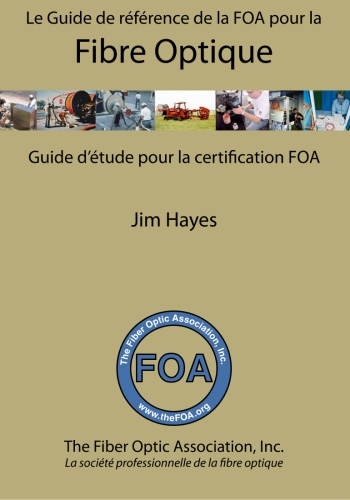
And the FOA Reference Guide To Fiber Optics: French Edition: Le
Guide de référence de la FOA pour la fibre optique et et
guide d'étude pour la certification FOA: Guide d'étude pour
la certification FOA Amazon Portuguese Edition: Guia de Referência sobre Fibra Óptica da FOA : Guia de Estudo para a Certificação da FOA Amazon The subject matter of these books is also translated in the FOA Guide online.
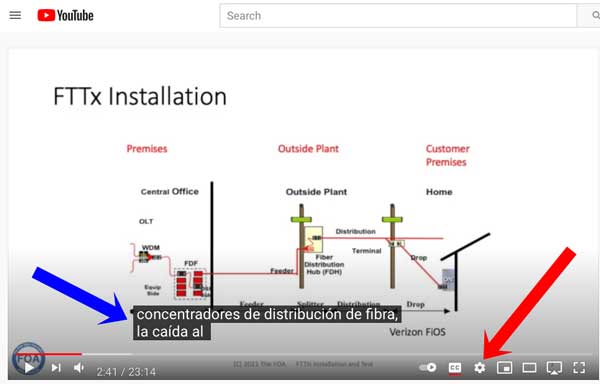
FOA Video
Lectures On YouTube
Did
you know YouTube will close caption videos in many
languages?
Sign in with Google to get translations for closed
captioning. Click on the settings icon (red arrow.)
Choose "Subtitles". English is the default
language. Click on the arrow after "English
(auto-generated) >". In the new window click on
"Auto-translate" and choose the language you
want.
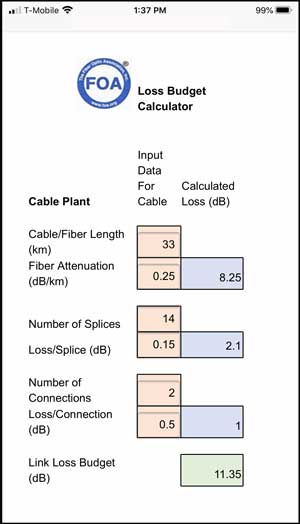
FOA Loss Budget
Calculator On A Web Page 5/2020
FOA
has written many articles about loss budgets,
something everyone involved in fiber optics needs to
know and needs to know how to calculate. We recently
discovered how to get a spreadsheet ported to a Web
page, so we created this web page that calculates
loss budgets. We have an iOS loss budget app, but
with this web page, you can calculate loss budgets
from any device, smart phone, tablet, laptop, or
desktop computer that has web browsing capability.
We are continually updating the Online Reference
Guide to keep up with changes in the industry and
adding lots of new pages of technical information.
When you go to the FOA
Guide Table of Contents to see the latest
updates - look for .
FOA Books
Fiber Optics (4 languages), Premises Cabling (2 languages), OSP
fiber and construction, Network Design, Testing,
FTTH Handbook and Fiber Broadband
The FOA has it's own
reference books for everyone working in fiber
optics - contractors, installers and end users as
well as for use as textbooks in classes at
educational institutions. They are available as
printed books or Kindle at much lower prices than
most textbooks since we self-publish. Click on the
individual book images for more information. The Reference
Guide To Fiber Optics is also available in
Spanish, French and Portuguese. The Design book is available in English
and Spanish.
Resources For
Teachers In K-12 And Technical Schools
Teachers in all grades can introduce their
students to fiber optic technology with some
simple demonstrations. FOA has created a page for
STEM or STEAM (science, technology, engineering, arts
and math) teachers with materials appropriate to
their classes. Fiber Optic Resources For
Teachers.
Safety
On Safety
New Fiber U Course: Fiber
Optic Safety
Safety
must be the first concern of everyone involved in a fiber optic
project, including those planning, designing, managing or supervising
and of course those doing the installation.
FOA is often asked about safety for fiber optics. Some
inquiries ask where it's covered in the FOA Online Guide or textbooks or
if we have a course on safety at Fiber U. Almost all Fiber
U Courses have lessons covering safety, because
safety is important in every aspect of a fiber optic project.
This
new Fiber U course will focus on safety alone. There are two lessons in this course,
fiber optic construction and fiber optic installation. The dividing
line between the two courses is the installation of the fiber optic
cables. Construction leads up to and/or is completed when the cables are
installed. Installation begins when the fiber tech installs the cable,
then completes the splicing, termination testing and documentation. The
overlap between the two is the installation of the cables where both
construction personnel and fiber optic techs are involved.
Here is the new Fiber U "Fiber Optic Safety" self-study program. Take the course and get your certificate of completion.
The FOA is concerned about safety! FOA
considers safety an integral part of all our
programs, curriculum materials and technical
materials. We start all our textbooks and their
online versions with a section on safety in the
first chapter, like this: Before
we get started - Safety First!
The FOA is a, international non-profit
educational association chartered to promote
professionalism in fiber optics through education,
certification and standards.
Founded in 1995 by a dozen prominent fiber optics
trainers and leaders from education,industry and governmentas a professional society for fiber
optics and a source of independent certification,
the FOA has grown to now being involved in numerous
activities to educate the world about fiber optics
and certify the workers who design, build and
operate the world's fiber optic networks.
Want to know more about fiber optics? Study
for FOA certifications? Free
Self-Study Programs are on "Fiber U®."
Looking for specific information? Here's the largest
technical reference on the web: The
FOA Online Fiber Optic Reference Guide.
Free online self-study programs
on many fiber optics and cabling topics are
available at Fiber U,
FOA's online web-based training website.
The
FOA has created a store on Zazzle.com offering lots
of new logo merchandise. It has lots of versions of
shirts and other merchandise with "FOA," "Fiber U,"
"Lennie Lightwave" designs and more so you should
find something just for you! See FOA on Zazzle.
Privacy Policy (for
the EU GDPR): The FOA does not
use cookies or any other web tricks to gather
information on visitors to our website, nor do
we allow commercial advertising. Our website
hosts may gather traffic statistics for the
visitors to our website and our online testing
service, ClassMarker, maintains statistics of
test results. We do not release or misuse any
information on any of our members except we will
confirm FOA certifications and Fiber U
certificates of completion when requested by
appropriate persons such as employers or
personnel services. Read
the complete FOA Privacy Policy here.

 The
LuLu — Kenyan Coastal Cable System is engineered to address localized
connectivity gaps along Kenya's Indian Ocean shoreline by pairing a
high-density subsea optical backbone with an integrated, parallel
terrestrial protection route. Lulu comprises of ~500 km coastal subsea
deployment along the Kenyan shoreline with 5 landing points with
redundant cables on shore for reliability.


 The
cleanliness of optical connectors is one of the important factors
affecting the reliability of optical networks, yet its importance is
often underestimated in practice. Connectors are often either not
cleaned at all or are cleaned improperly. Contamination can increase
insertion loss and reflectance, and it can even cause the interruption
of one or all services on a network. In addition, it can cause permanent
damage to connector end faces. And a dirty connector can contaminate or
damage clean connectors.











 Here
at FOA, we were even surprised that we never created a course just for
splicing. When asked how to prepare for the CFOS/S certification, we
sent people to the lessons in Basic Fiber Optics and the Basics Skills
Lab on splicing and termination. But now








 .